
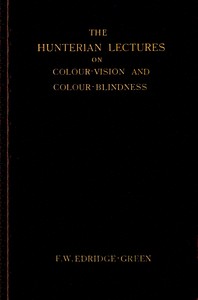
The Hunterian lectures on colour-vision and colour-blindness by F. W. Edridge-Green
Published in 1911, this book collects a series of lectures given by Dr. F. W. Edridge-Green. It's not a novel with a plot in the traditional sense. The 'story' here is the argument itself. Edridge-Green presents his complete theory of color vision, which directly challenged the dominant Young-Helmholtz theory that had been accepted for decades.
The Story
Imagine a respected doctor and scientist stepping onto a major stage to tell all his peers they've been wrong for years. That's the core of this book. Edridge-Green didn't just study color blindness; he had a whole new idea about how the eye and brain work together to create color. He argued that the standard tests for color blindness were flawed and that his own method was the correct one. The book lays out his evidence, explains his experiments, and builds his case point by point. The tension comes from his forceful, confident voice pushing against the weight of accepted science.
Why You Should Read It
It's a fascinating look at how science really progresses—not always smoothly, but through debate and disagreement. Edridge-Green's writing is direct and surprisingly accessible. You get a real sense of his personality; he was clearly a man on a mission. While some of the science is dated, the human story isn't. It's about conviction, the struggle for acceptance, and the passion behind a big idea. Reading his detailed descriptions of color perception makes you stop and think about your own reality. How do I really know the red I see is the same as yours? This book pushes those questions to the front of your mind.
Final Verdict
This is not for everyone. It's a specialized scientific text. But if you're curious about the history of science, psychology, or medicine, it's a gem. It's perfect for readers who love primary sources and seeing historic arguments unfold firsthand. Think of it as a time capsule of a scientific revolution that didn't quite happen as its author hoped. You're getting the unfiltered perspective of the underdog, which is always a compelling read.




Steven Young
1 year agoThis book was worth my time since it challenges the reader's perspective in an intellectual way. Definitely a 5-star read.