About 84 minutes
Poems of love — A Reader’s Guide
Historical Psychological Social Fiction
19,253 recorded words. 2 minutes difference from this book's estimate.
View Gutenberg source #74968
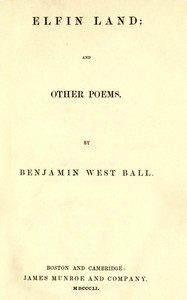
The catalog record for Elfin land: and other poems — Story, Setting & Ideas provides practical reading context through 18,743 words, 1 hr 22 min estimated reading time, and 58 detected text sections.
The text analysis averages about 24.9 words per sentence, while the detected sections provide another way to judge how the source is divided.
Project Gutenberg metadata also associates the work with “American poetry -- 19th century,” connecting these edition facts with the source record’s subject description.
Explore this collection
These alternatives are selected using recorded categories and estimated reading time.
About 84 minutes
Historical Psychological Social Fiction
19,253 recorded words. 2 minutes difference from this book's estimate.
View Gutenberg source #74968About 77 minutes
Historical Psychological Social Fiction
17,611 recorded words. 5 minutes difference from this book's estimate.
View Gutenberg source #64148About 73 minutes
Historical Psychological Social Fiction
16,635 recorded words. 9 minutes difference from this book's estimate.
View Gutenberg source #207Search stored excerpts and compare books → Choose by your preferences →
Choices use stored catalog measurements. Estimates vary with reading speed. A shared category is a catalog label, not a claim that two books have the same argument or literary quality.
Search reads excerpt text stored with this catalog and links to its associated Gutenberg record. The connection is stored in the site database; this tool does not recheck that every excerpt is word-for-word identical to that external record. Excerpt search does not cover every chapter and does not verify historical publication dates.
Catalog snapshot checked: 2026-09-26. Coverage: 94 public books, 94 available source excerpts.
Calculated from edition completeness, EPUB availability, text structure and catalogue metadata. Not a user rating.
Total of 100 points, scaled to a 2.5-5.0 range. Editions with an empty description or a missing EPUB file are not scored.
Public-domain source text
The source text is kept in the dedicated reader, separate from this catalogue record and its commentary.
Benjamin West Ball's Elfin Land: and Other Poems (1851) opens with a dedication poem that establishes a pattern of idealized longing: the speaker recalls a "morning dream" of a beloved figure "in perfect beauty moulded," then confesses to have carried the memory of that "shade impalpable" until the real person appeared. This tension between ethereal vision and tangible presence runs through the collection, which juxtaposes mythological fantasy with intimate lyricism.
The volume's title poem, "Elfin Land," is divided into two parts and draws on folklore, while shorter pieces range from a threnody for the Countess of Nettlestede to a meditation on a cemetery in summer. Ball's verse is formally varied—employing quatrains, sonnets, and irregular stanzas—and frequently invokes classical figures such as Pan, Eros, and Göthe's Faust.
The opening dedication introduces a central tension: the beloved is first encountered as a "phantom" in a dream, then later recognized in the flesh. The speaker describes himself as "of shade impalpable the lover," a phrase that captures the collection's preoccupation with the boundary between imagination and actuality. In the title poem, this motif recurs when the narrator mistakes a "gorgeous bird" for something more—only to have his error "soon become apparent." The bird, named Cymindis, sings a "lengthened flow of moist Memnonian melody" before being killed by a vulture, a sudden shriek that breaks the rapture. Ball repeatedly stages moments where a vision or sound is interrupted, suggesting that the ideal cannot be sustained.
Birds function as both symbols and structural devices across the collection. In the excerpt from "Cymindis," the bird's song is described in elaborate musical terms: a "flute's low silvery plaining," a "shepherd's reed," a "far-off clarion's exclaiming," and finally an "Æolian harmony." This layering of sound creates a sense of plenitude, yet the narrative arc moves from song to silence—the vulture's attack "hushed to silence" the descant. Similarly, in "The Cemetery in Summer," the speaker hears only a "low eternal threne" woven by the wind, and the "din of life" becomes a "murmur." The contrast between vibrant music and quiet death is a recurring pattern.
Ball's verse is steeped in classical and literary references. The dedication invokes "that sweet Göthéan vision" from Faust, while "Pan and Laïs" and "Achilles' Song" draw directly on myth. The poem "The Authoress of the Mysteries of Udolpho" signals an interest in Gothic romance, and "The Lay of the Condemned Spirit in Dante" adapts a scene from the Inferno. Yet these allusions are often undercut by a melancholic tone: in "The Cemetery in Summer," the figure of Eros appears "with torch reversed and falling tear," a conventional emblem of mourning. The classical world is not revived but elegized, and the Gothic elements—like the "spectres thin" in the cemetery—are subdued, more atmospheric than horrific.
Readers approaching Elfin Land will find a poet who moves fluidly between personal lyric and mythological narrative, but who consistently returns to themes of transience and loss. The collection rewards attention to its sound patterns—the way birdsong, wind, and human voice echo and fall silent. Ball's classical learning is worn lightly, and his most effective poems are those where the ideal and the actual collide, leaving the speaker in a state of suspended longing.
Some books don’t leave when you close them. Elfin land stayed with me that way—its quiet ache about love and time, wrapped in moonlight and birdsong. It reminded me of another voice that lingers similarly, tender and unhurried, in Poems of love — A Reader’s Guide. There’s a softness there, like remembering someone you once held gently.
Capture what you thought, learned, and would like to remember.









