About 58 minutes
The three sphinxes, and other poems — A Closer Reading
Fantasy Juvenile Worlds
13,193 recorded words. 2 minutes difference from this book's estimate.
View Gutenberg source #76846
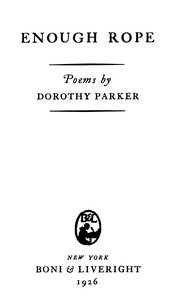
The catalog record for Enough rope: poems — Reading Companion provides practical reading context through 12,693 words, 56 min estimated reading time, and 3 detected text sections.
The text analysis averages about 19.2 words per sentence, while the detected sections provide another way to judge how the source is divided.
Project Gutenberg metadata also associates the work with “American poetry -- 20th century,” connecting these edition facts with the source record’s subject description.
Explore this collection
These alternatives are selected using recorded categories and estimated reading time.
About 58 minutes
Fantasy Juvenile Worlds
13,193 recorded words. 2 minutes difference from this book's estimate.
View Gutenberg source #76846About 53 minutes
Fantasy Juvenile Worlds
12,081 recorded words. 3 minutes difference from this book's estimate.
View Gutenberg source #1830About 53 minutes
Fantasy Juvenile Worlds
12,036 recorded words. 3 minutes difference from this book's estimate.
View Gutenberg source #3009Search stored excerpts and compare books → Choose by your preferences →
Choices use stored catalog measurements. Estimates vary with reading speed. A shared category is a catalog label, not a claim that two books have the same argument or literary quality.
Search reads excerpt text stored with this catalog and links to its associated Gutenberg record. The connection is stored in the site database; this tool does not recheck that every excerpt is word-for-word identical to that external record. Excerpt search does not cover every chapter and does not verify historical publication dates.
Catalog snapshot checked: 2026-09-26. Coverage: 94 public books, 94 available source excerpts.
Calculated from edition completeness, EPUB availability, text structure and catalogue metadata. Not a user rating.
Total of 100 points, scaled to a 2.5-5.0 range. Editions with an empty description or a missing EPUB file are not scored.
Public-domain source text
The source text is kept in the dedicated reader, separate from this catalogue record and its commentary.
Dorothy Parker's Enough Rope (1926) opens with a threnody that immediately establishes a signature tension: the speaker's heart is shattered, yet the poem's logic undercuts the tragedy. 'If I bowled it down the street, / Who's to say it mattered?' Parker pairs grief with a shrug, then pivots to a wry consolation—'the empty breast / Is the softer pillow'—that turns loss into a practical advantage. This pattern of emotional exposure followed by a defensive retreat recurs throughout the collection.
The poems are populated by speakers who are simultaneously vulnerable and armored. In 'Love Song,' the beloved is 'strong and bold' and 'all my world,' but the final line wishes 'somebody'd shoot him.' Parker's voice is conversational, often rhyming with a deceptive lightness that masks sharper observations about love, memory, and self-deception.
Parker's speakers frequently confess to weakness or longing, only to undercut the confession with irony or defiance. In 'Ballade at Thirty-five,' the refrain 'I loved them until they loved me' transforms devotion into a self-protective pattern: once love is reciprocated, the speaker withdraws. The poem's l'envoy addresses 'Princes' with a plea for tenderness, but the final line—'Here's my strength and my weakness, gents'—blurs the line between vulnerability and performance.
This technique appears in shorter poems as well. 'The Small Hours' describes lying awake 'to watch the black / And wait the unfailing gray,' a stark image of insomnia and sorrow, yet the poem's title and measured rhythm keep emotion at a distance. 'Indian Summer' delivers a blunt reversal: after years of trying to please, the speaker declares, 'And if you do not like me so, / To hell, my love, with you!' The shift from accommodation to dismissal is abrupt, suggesting that the earlier compliance was always provisional.
Certain images and phrases recur across the collection, creating internal echoes. Roses appear in multiple contexts: 'One Perfect Rose' mocks the predictability of romantic gestures ('A single flow'r he sent me, since we met'), while 'The White Lady' and other poems use floral imagery more conventionally. Tears are both a sign of grief and, in 'Threnody,' a practical asset—'Lips that taste of tears, they say, / Are the best for kissing.' The 'whistling lad' appears in 'For an Unknown Lady' as a figure of temptation, and again in 'Threnody' as the one who 'rode away.'
Parker also returns to the motif of the heart as a fragile object. In 'Threnody,' a heart 'falls tinkling down' but is quickly gathered up by 'every likely lad in town.' 'The Leal' speaks of friendships that 'slipped and strayed,' and the speaker's response is a studied indifference: 'A trifling lot and best forgot.' These repeated images build a lexicon of emotional risk and self-preservation.
Parker demonstrates a command of traditional forms while often subverting their expectations. The collection includes ballades, rondeaus, songs, and epitaphs, but the content rarely matches the form's conventional gravity. 'Ballade of a Great Weariness' uses the ornate ballade structure to catalogue exhaustion, while 'Résumé'—a short poem—delivers a famously dark punchline about suicide methods. The juxtaposition of strict form and sardonic content creates a persistent irony.
Several poems employ refrains that accumulate meaning. 'The Thin Edge' ends each stanza with a variant of 'I wonder what it's like in Spain,' a line that seems deliberately trivial against the poem's quiet domesticity. 'Song of Perfect Propriety' uses a repeating structure to mock social expectations. Parker also experiments with voice: 'A Very Short Song' compresses a complete emotional arc into four lines, while 'News Item' achieves its effect through a single couplet. This formal range keeps the collection varied, even as thematic concerns remain consistent.
Reading Enough Rope sequentially reveals the interplay between individual poems: a cynical statement in one may be answered by a more vulnerable one later. Parker's speakers are not consistent characters but shifting personas, and the collection's power lies in the gaps between them. Pay attention to how she uses rhyme and meter to create a conversational tone that can pivot from intimacy to dismissal in a single line. The poems reward rereading for their compression and their refusal to settle into a single emotional register.
I came back to Enough Rope this evening, and Parker’s wry ache in “Threnody” lingered oddly in my mind—the way we dress our wounds in cleverness. That tension reminded me, quiet as a memory, of another collection I once kept nearby: The flying parliament, and other poems — Story, Setting & Ideas. Something in its flight, too, felt like a held breath.
Create a short personal record of your experience with this book.









