About 46 minutes
April twilights, and other poems — Inside the Classic
Science Fiction Utopias
10,548 recorded words. 1 minutes difference from this book's estimate.
View Gutenberg source #64318
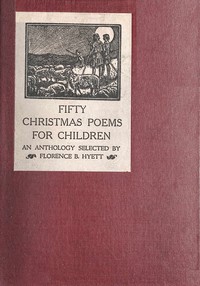
This digital edition of Fifty Christmas poems for children — Inside the Classic is described by source-level measurements including 10,736 words, 47 min estimated reading time, and 52 detected text sections.
The text analysis averages about 23.0 words per sentence, while the detected sections provide another way to judge how the source is divided.
Project Gutenberg metadata also associates the work with “Children's poetry,” connecting these edition facts with the source record’s subject description.
Explore this collection
These alternatives are selected using recorded categories and estimated reading time.
About 46 minutes
Science Fiction Utopias
10,548 recorded words. 1 minutes difference from this book's estimate.
View Gutenberg source #64318About 51 minutes
Science Fiction Utopias
11,529 recorded words. 4 minutes difference from this book's estimate.
View Gutenberg source #70771About 42 minutes
Science Fiction Utopias
9,613 recorded words. 5 minutes difference from this book's estimate.
View Gutenberg source #442Search stored excerpts and compare books → Choose by your preferences →
Choices use stored catalog measurements. Estimates vary with reading speed. A shared category is a catalog label, not a claim that two books have the same argument or literary quality.
Search reads excerpt text stored with this catalog and links to its associated Gutenberg record. The connection is stored in the site database; this tool does not recheck that every excerpt is word-for-word identical to that external record. Excerpt search does not cover every chapter and does not verify historical publication dates.
Catalog snapshot checked: 2026-09-26. Coverage: 94 public books, 94 available source excerpts.
Calculated from edition completeness, EPUB availability, text structure and catalogue metadata. Not a user rating.
Total of 100 points, scaled to a 2.5-5.0 range. Editions with an empty description or a missing EPUB file are not scored.
Public-domain source text
The source text is kept in the dedicated reader, separate from this catalogue record and its commentary.
Florence B. Hyett's 1923 anthology gathers fifty Christmas poems for children, drawing on anonymous carols and works by poets such as Christina Rossetti, Eugene Field, and Eleanor Farjeon. The collection favors short, lyrical pieces that often employ repetition and simple rhyme schemes, as seen in the anonymous 'Old Carol' with its repeated 'He came all so still' and the simile 'As dew in April.' Many poems adopt a hushed, reverent tone, focusing on the Nativity scene rather than festive celebration.
A striking feature across the anthology is the use of repetition to create rhythm and emphasis. In 'Old Carol,' the phrase 'He came all so still' recurs three times, each followed by a variation of 'As dew in April.' This pattern mirrors the gentle, incremental unfolding of the Nativity story. Similarly, Eugene Field's 'Star of the East' builds its final stanza around the repeated appeal 'Star of the East! show us the way,' reinforcing the poem's prayer-like quality. Eleanor Farjeon's 'Six Green Singers' employs a question-and-answer structure, with each stanza beginning 'What do ye...' or 'Where do ye...'—a device that gives the poem a folk-ballad cadence. These repetitive elements not only aid memorization for young readers but also create a meditative, almost incantatory atmosphere that distinguishes the collection from more narrative-heavy Christmas verse.
Several poems in the anthology juxtapose vast, cosmic imagery with intimate, domestic details. Christina Rossetti's 'A Christmas Carol' opens with 'Before the paling of the stars, / Before the winter morn,' setting the Nativity in a pre-dawn, universal frame, yet immediately narrows to 'Born in a stable, / Cradled in a manger.' George Macdonald's 'That Holy King' contrasts the expectation of a conquering king with the reality of 'a little baby thing / That made a woman cry.' The anonymous 'Yule-Tide Fires' moves from the specific instruction to 'Cleanse with the burning log of oak' to the cosmic image of 'a pale star rose in the East.' This oscillation between the grand and the humble is a deliberate structural choice, reminding readers that the Christmas story encompasses both the divine and the everyday.
Across the fifty poems, natural elements—especially dew, stars, animals, and plants—recur as carriers of symbolic meaning. The anonymous 'Old Carol' compares Christ's coming to 'dew in April,' evoking gentleness and renewal. In 'Yule-Tide Fires,' the 'burning log of oak' and 'scarlet-berried bough' ground the spiritual message in tangible seasonal rituals. Eleanor Farjeon's 'Six Green Singers' personifies holly, mistletoe, laurel, yew, fir, and ivy as 'green singers' who bring gifts for the house, blending nature with the Christmas story. The star appears prominently in Eugene Field's 'Star of the East' and in the final stanza of 'Yule-Tide Fires,' linking the celestial to human hope. This consistent use of natural imagery creates a cohesive sensory world, where the physical landscape of winter becomes a stage for spiritual reflection.
Readers approaching this anthology will find that its brevity and variety invite multiple sittings. The poems reward attention to their rhythmic patterns and the way they balance the familiar with the unexpected. Not all pieces are explicitly religious; some, like 'Yule-Tide Fires,' emphasize charity and domestic ritual. Noticing how each poet handles the same core themes—incarnation, waiting, gift-giving—can deepen appreciation for the collection's range.
When I hold Fifty Christmas Poems for Children, its quiet reverence reminds me of evenings by lamplight, hushed and hopeful somewhere between a carol and a prayer. That same unhurried solemnity lives, oddly, in Gebir, and Count Julian — A Reader’s Guide, where old grief and distant shores ask only for patience. Different seasons, perhaps, but the same steady hand turning pages beneath worn reading gloves.
A brief reflection can help important ideas stay with you longer.









