About 354 minutes
The Fall of the Nibelungs — Themes and Context
Adventure Picaresque Fiction
81,325 recorded words. 65 minutes difference from this book's estimate.
View Gutenberg source #3636
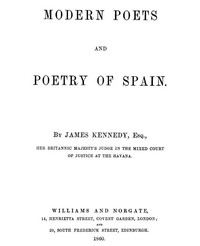
The source record for Modern Poets and Poetry of Spain — Themes and Context measures this digital text at 96,357 words, 6 hr 59 min estimated reading time, and 15 detected text sections.
The text analysis averages about 28.7 words per sentence, while the detected sections provide another way to judge how the source is divided.
Project Gutenberg metadata also associates the work with “Spanish poetry -- History and criticism,” connecting these edition facts with the source record’s subject description.
Explore this collection
These alternatives are selected using recorded categories and estimated reading time.
About 354 minutes
Adventure Picaresque Fiction
81,325 recorded words. 65 minutes difference from this book's estimate.
View Gutenberg source #3636About 322 minutes
Adventure Picaresque Fiction
73,955 recorded words. 97 minutes difference from this book's estimate.
View Gutenberg source #5210About 312 minutes
Adventure Picaresque Fiction
71,629 recorded words. 107 minutes difference from this book's estimate.
View Gutenberg source #2622Search stored excerpts and compare books → Choose by your preferences →
Choices use stored catalog measurements. Estimates vary with reading speed. A shared category is a catalog label, not a claim that two books have the same argument or literary quality.
Search reads excerpt text stored with this catalog and links to its associated Gutenberg record. The connection is stored in the site database; this tool does not recheck that every excerpt is word-for-word identical to that external record. Excerpt search does not cover every chapter and does not verify historical publication dates.
Catalog snapshot checked: 2026-09-26. Coverage: 94 public books, 94 available source excerpts.
Calculated from edition completeness, EPUB availability, text structure and catalogue metadata. Not a user rating.
Total of 100 points, scaled to a 2.5-5.0 range. Editions with an empty description or a missing EPUB file are not scored.
Public-domain source text
The source text is kept in the dedicated reader, separate from this catalogue record and its commentary.
James Kennedy’s Modern Poets and Poetry of Spain (1860) is as much a portrait of the translator as of the poets he presents. In the dedication, Kennedy explains that he began translating Spanish verse partly as a language exercise and partly as relaxation—a modest origin that belies the ambition of the anthology. The work weaves biographical sketches with translated poems, and the reader quickly notices that Kennedy’s own voice intrudes frequently, offering opinions on politics, character, and poetic merit. This dual presence—the poet and the commentator—creates an unusual reading experience where the anthology becomes a dialogue between cultures and eras.
Kennedy does not hide his presence. In the dedication, he recounts how discussions about Lord Carlisle’s 1842 visit to Cuba prompted reflections on travel writing and cultural knowledge. He argues that transient visitors cannot convey “the state of mental culture” of a people, and that poetry offers a truer test of civilization. This framing positions Kennedy as a mediator who has spent time in Spanish-speaking regions (he was a British judge in Havana) and can therefore provide insight beyond that of a casual tourist. Yet his biographical entries often read like political defenses: for Martínez de la Rosa, he insists that the statesman “would not conspire even for good ends unlawfully,” and that failure in office does not imply failure of character. These asides reveal Kennedy’s own values—moderation, justice, and a belief that poetry reveals national character—and they shape how the reader encounters the poems.
The anthology’s structure gives equal weight to life and work. For each poet, Kennedy provides a prose account of their career, often focusing on political exile or persecution. Martínez de la Rosa, for example, is described as having been imprisoned and exiled for his role in the Constitution of 1812, then later recalled to form a ministry. Kennedy notes that during eight years in Paris, the poet composed his most famous works, including the “Ode on the Death of the Duchess de Frias” and the tragedy Conspiracy of Venice. This biographical framing invites the reader to see the poems as responses to historical pressures. However, Kennedy’s summaries are selective: he does not quote extensively from the poems themselves in the biographical sections, leaving the reader to connect life and art without explicit guidance. The effect is that the biographies stand almost as independent narratives, with the poems serving as appendices.
The book’s pacing shifts between dense biographical prose and the lyric compression of translated verse. Kennedy’s sentences in the biographical sections are often long and clause-heavy, as when he writes that Martínez de la Rosa “learned soon to perceive that [the Constitution of 1812] required considerable modifications in a country like Spain, where the people were not fully prepared to receive it.” This measured, analytical tone contrasts with the poems, which—though translated into English—retain a different rhythmic quality. The reader must adjust between the voice of the commentator and the voice of the poet. Kennedy occasionally interrupts his own narrative to insert a poem, and the effect is jarring: the reader is pulled from historical exposition into lyric immediacy. This alternation creates a distinctive reading experience, one that rewards attention to both the frame and the framed.
Readers approaching Modern Poets and Poetry of Spain should be prepared for a work that is as much about the translator’s encounter with Spanish culture as it is about the poets themselves. Kennedy’s biographical sketches are worth reading for their own sake, but they also set expectations that the poems may or may not fulfill. The anthology is best approached as a historical document of cross-cultural literary exchange, one that reveals how a 19th-century British judge understood and valued Spanish verse. Pay attention to the moments when Kennedy steps back and lets the poems speak—and to the moments when he cannot resist adding his own commentary.
That rain fell straight for hours, and I sat with Kennedy’s translations, hearing Spanish melancholy through his Victorian stiffeners. When I finally set it down, a smaller book surfaced from the shelf—A Child’s Garden of Verses — A Closer Reading—and I remembered childhood’s simpler shadows, not so far from those old poets’ longing, just quieter.
Capture what you thought, learned, and would like to remember.









