About 38 minutes
Lamia — Reading Companion
Science Fiction Utopias
8,551 recorded words. 1 minutes difference from this book's estimate.
View Gutenberg source #2490
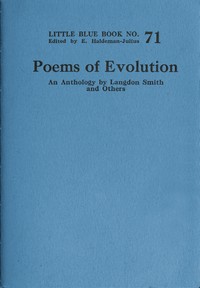
The source record for Poems of evolution — Background and Themes measures this digital text at 8,921 words, 39 min estimated reading time, and 25 detected text sections.
The text analysis averages about 23.6 words per sentence, while the detected sections provide another way to judge how the source is divided.
Project Gutenberg metadata also associates the work with “American poetry -- 19th century,” connecting these edition facts with the source record’s subject description.
Explore this collection
These alternatives are selected using recorded categories and estimated reading time.
About 38 minutes
Science Fiction Utopias
8,551 recorded words. 1 minutes difference from this book's estimate.
View Gutenberg source #2490About 42 minutes
Science Fiction Utopias
9,613 recorded words. 3 minutes difference from this book's estimate.
View Gutenberg source #442About 46 minutes
Science Fiction Utopias
10,548 recorded words. 7 minutes difference from this book's estimate.
View Gutenberg source #64318Search stored excerpts and compare books → Choose by your preferences →
Choices use stored catalog measurements. Estimates vary with reading speed. A shared category is a catalog label, not a claim that two books have the same argument or literary quality.
Search reads excerpt text stored with this catalog and links to its associated Gutenberg record. The connection is stored in the site database; this tool does not recheck that every excerpt is word-for-word identical to that external record. Excerpt search does not cover every chapter and does not verify historical publication dates.
Catalog snapshot checked: 2026-09-26. Coverage: 94 public books, 94 available source excerpts.
Calculated from edition completeness, EPUB availability, text structure and catalogue metadata. Not a user rating.
Total of 100 points, scaled to a 2.5-5.0 range. Editions with an empty description or a missing EPUB file are not scored.
Public-domain source text
The source text is kept in the dedicated reader, separate from this catalogue record and its commentary.
Langdon Smith's 'Evolution,' the centerpiece of this 1924 Little Blue Book anthology, traces a love story across geological deep time. The poem's nine stanzas move from the Paleozoic era—where the speaker and beloved are 'a tadpole' and 'a fish'—through amphibian, reptilian, and mammalian forms, finally arriving at a 'fireless cave' where the speaker, now 'thewed like an Auroch bull,' flints a spear. This structure mirrors the Victorian 'great chain of being' but recasts it as a personal, romantic progression.
The anthology, edited by E. Haldeman-Julius, collects additional poems by William Herbert Carruth, Thomas Bailey Aldrich, and Maurice Thompson, each engaging with evolutionary themes. The volume's brevity (8,921 words) and its inclusion of explanatory notes on geological terms suggest an audience curious about science but seeking poetic, rather than technical, treatment.
Smith organizes his poem by geological periods, each stanza corresponding to a distinct era. The first stanza opens in the 'Paleozoic time' and 'Cambrian fen'; the second mentions 'Caradoc drift'; the fourth, 'Neocomian shore.' This is not mere decoration—the notes appended to the poem define each term, from the Cambrian's 'lowest primary strata' to the Neocomian's 'lower division of the cretaceous system.' The structure thus functions as a poetic stratigraphy, where each stanza is a layer of time containing its own life forms and emotional register.
The movement is linear but punctuated by death and rebirth: 'Mindless we lived and mindless we loved, / And mindless at last we died' is followed by 'we caught our breath from the womb of death, / And crept into light again.' This cyclical pattern within a linear framework gives the poem a rhythmic, almost liturgical quality, as if evolution itself were a series of resurrections.
Throughout Smith's poem, the body is described in terms of its material origins: 'ooze and slime,' 'scaled and tailed,' 'three-clawed feet,' 'gowned in your glorious hair.' The physicality is unflinching—the lovers 'mumbled the bones of the slain' and 'drave the stone' into a mammoth. Yet this gross matter is also the site of tenderness: 'My heart was rife with the joy of life / For I loved you even then.'
The imagery of water and land transition recurs: 'ebbing tide,' 'depths of the Cambrian fen,' 'trailed through the mud and sand.' The poem's world is one of constant flux, where bodies are 'rolled in the clinging mold' only to be 'riven away in a newer day.' This emphasis on the physical—scales, claws, hair, bones—grounds the abstract concept of evolution in sensory, often visceral, detail.
The poem's scenes shift dramatically: from aquatic sprawl to amphibian croaking, from swinging through 'jungle trees' to huddling in a 'fireless cave,' and finally to a vision of 'the moon hung red o'er the river bed.' Each transition is marked by a change in locomotion—swimming, crawling, swinging, walking—and a change in habitat. The notes indicate that after stanza IV, the author 'ceases to trace the developments of life through the early geological formations' and moves to the Tertiary period, a shift that accelerates the narrative pace.
Thomas Bailey Aldrich's contribution, 'Progress,' employs a different kind of movement: the speaker is a bird that 'circled near and nearer to the earth,' then 'stole and nestled in her bosom,' and finally 'came here, / To walk the earth and wear the form of Man.' This vertical descent from sky to human form contrasts with Smith's horizontal crawl through time, offering a complementary perspective on evolutionary ascent.
The anthology juxtaposes precise geological terminology with religious and metaphysical vocabulary. Smith's poem ends with 'a strange, dim dream of God,' while Carruth's opening quatrain declares: 'Some call it EVOLUTION, / And some call it GOD.' The notes cite Darwin and Huxley, grounding the poetry in contemporary science, yet the poems repeatedly invoke the soul, God, and love as evolutionary drivers.
Maurice Thompson's 'The Final Thought' resolves this tension by asserting 'Love is the final thought.' The anthology thus presents evolution not as a mechanistic process but as a teleological one, where matter gradually becomes spirit. This dual framing—scientific fact and spiritual meaning—reflects the broader cultural negotiation of Darwinism in early 20th-century America, making the volume a document of its time as much as a literary collection.
Readers approaching this anthology should attend to the interplay between the poems and their explanatory notes. The notes are not afterthoughts but integral to the reading experience, glossing terms like 'Caradoc drift' and 'Neocomian' that anchor the verse in specific scientific contexts. The volume's brevity invites multiple readings: one for the narrative sweep of Smith's evolutionary love story, another for the quieter, more philosophical poems that follow. Consider how each poet handles the same theme—descent, ascent, or transformation—and what that reveals about the era's hopes and anxieties regarding humanity's place in nature.
I’ve shelved that 1924 anthology for decades, tracing Langdon Smith’s ooze to consciousness, yet it’s the same slow ache I feel in Love Songs — Inside the Classic. Different geology, same strata: matter yearning upward. Each poet mistook longing for evolution, and I, for one, never corrected them.
Capture what you thought, learned, and would like to remember.









