About 37 minutes
The Witch of Atlas — Themes and Context
Fantasy Juvenile Worlds
8,356 recorded words. 5 minutes difference from this book's estimate.
View Gutenberg source #4696
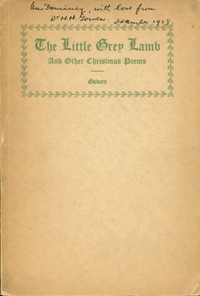
The source record for The little grey lamb, and other Christmas poems — Reading Companion measures this digital text at 9,509 words, 42 min estimated reading time, and 2 detected text sections.
The text analysis averages about 22.1 words per sentence, while the detected sections provide another way to judge how the source is divided.
Project Gutenberg metadata also associates the work with “Christmas poetry,” connecting these edition facts with the source record’s subject description.
Explore this collection
These alternatives are selected using recorded categories and estimated reading time.
About 37 minutes
Fantasy Juvenile Worlds
8,356 recorded words. 5 minutes difference from this book's estimate.
View Gutenberg source #4696About 53 minutes
Fantasy Juvenile Worlds
12,081 recorded words. 11 minutes difference from this book's estimate.
View Gutenberg source #1830About 53 minutes
Fantasy Juvenile Worlds
12,036 recorded words. 11 minutes difference from this book's estimate.
View Gutenberg source #3009Search stored excerpts and compare books → Choose by your preferences →
Choices use stored catalog measurements. Estimates vary with reading speed. A shared category is a catalog label, not a claim that two books have the same argument or literary quality.
Search reads excerpt text stored with this catalog and links to its associated Gutenberg record. The connection is stored in the site database; this tool does not recheck that every excerpt is word-for-word identical to that external record. Excerpt search does not cover every chapter and does not verify historical publication dates.
Catalog snapshot checked: 2026-09-26. Coverage: 94 public books, 94 available source excerpts.
Calculated from edition completeness, EPUB availability, text structure and catalogue metadata. Not a user rating.
Total of 100 points, scaled to a 2.5-5.0 range. Editions with an empty description or a missing EPUB file are not scored.
Public-domain source text
The source text is kept in the dedicated reader, separate from this catalogue record and its commentary.
Herbert H. Gowen's The Little Grey Lamb, and Other Christmas Poems (1928) began as annual Christmas greetings to friends, later collected with permission from the Town-Crier of Seattle. The foreword presents the poems as a deliberately varied treatment of the Christmas story, and the collection lives up to that claim: Gowen shifts between narrative, lyric, and dramatic modes, often adopting unusual viewpoints. The opening prose preface, “The Christmas Message,” sets a theological tone by comparing King Edward I’s presentation of his son to the Welsh with the Incarnation, but the poems themselves are more concrete and image-driven. Gowen’s voice ranges from the colloquial rhythms of “No Room in the Inn” to the incantatory repetitions of “Mother and Child,” revealing a poet attentive to both sound and structure.
Gowen frequently abandons the omniscient narrator in favor of specific, often marginalized speakers. In “No Room in the Inn,” the poem is voiced by a figure who overhears the revelers inside the inn—their song is rendered in mocking, italicized quatrains: “No room, no room, in the world’s wide Inn, / For Age when the wine of life is thin!” The speaker then counters with a vision of the stable as “the rock of God’s eternal plan.” This dialogic structure creates a tension between the crowd’s dismissal and the speaker’s affirmation. Elsewhere, “The Little Grey Lamb” presumably adopts the lamb’s perspective (though the excerpt does not include the full poem). The preface’s mention of the Japanese “Guiding Bell” shrine, with its rope of dead children’s bibs, suggests Gowen’s willingness to draw on non-Western imagery, though the poems themselves remain firmly within the Nativity tradition.
Gowen varies his metrical choices to match the emotional register of each poem. “No Room in the Inn” uses a loose anapestic rhythm in the crowd’s song, mimicking a drinking chant, while the speaker’s response shifts to a more stately iambic line. In “Mother and Child,” the opening lines—“Mother and Child! Symbol eternal, and Fact, / Prediction sublime!”—employ a dactylic, almost hymn-like cadence, reinforced by internal rhyme and alliteration. The long, sweeping lines of the Earth-Mother passage (“Far back in the youth of the world, out of water and mist and slime”) create a sense of evolutionary time, slowing the pace to a geological crawl before returning to the intimate image of Mary and the Christ child. This alternation between rapid, conversational verse and slow, meditative lines gives the collection a rhythmic variety that rewards reading aloud.
Throughout the excerpts, Gowen returns to a small set of concrete images: the stable, the inn, bells, and light. The stable is consistently portrayed as a site of inversion—the place where the weak are banished becomes the foundation of God’s plan. In “No Room in the Inn,” the speaker declares, “This stable whither ye the weak ones ban, / Stands on the rock of God’s eternal plan.” Light imagery appears in the “Guiding Bell” passage and in the closing lines of “The Christmas Message,” where bells “summon man unfailingly to a Paradise.” The contrast between the inn’s artificial light (revelry, feasting) and the stable’s humble illumination (the star, the child) is a subtle but persistent motif. Gowen also uses the phrase “the light which burns eternally” in a fragment, linking the Christmas story to a universal, unending illumination that transcends the specific setting.
Readers approaching this collection should attend to Gowen’s habit of embedding multiple voices within a single poem—the crowd, the speaker, the narrator—and to the way he uses meter to signal shifts in tone. The poems are best read as individual pieces rather than a continuous narrative; the foreword’s admission that they were originally separate greetings explains their self-contained quality. For those interested in early twentieth-century religious poetry, Gowen’s work offers a modest but craftsmany example of how traditional Christmas themes could be refreshed through formal experimentation and empathetic point of view.
There are books that seem to wait for a certain season, and The Little Grey Lamb always felt that way to me—its quiet Christmas whispers, the animals watching. I often set it beside a slender volume called Truth and the Myth: Couplet Quips — A Reader’s Guide, for both share a fondness for seeing the familiar story from the side, catching the truth in the turning of a line. They keep each other company on the shelf, like old acquaintances who need no words.
Use these questions to collect your thoughts before moving on.









