About 95 minutes
Saltbush Bill, J. P. — Themes and Context
Fantasy Juvenile Worlds
21,689 recorded words. 1 minutes difference from this book's estimate.
View Gutenberg source #1317
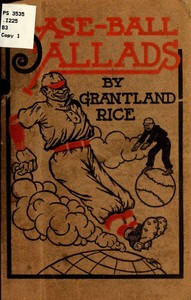
The source record for Base-ball Ballads — Background and Themes measures this digital text at 21,880 words, 1 hr 36 min estimated reading time, and 5 detected text sections.
The text analysis averages about 23.7 words per sentence, while the detected sections provide another way to judge how the source is divided.
Project Gutenberg metadata also associates the work with “Baseball -- Poetry,” connecting these edition facts with the source record’s subject description.
Explore this collection
These alternatives are selected using recorded categories and estimated reading time.
About 95 minutes
Fantasy Juvenile Worlds
21,689 recorded words. 1 minutes difference from this book's estimate.
View Gutenberg source #1317About 88 minutes
Fantasy Juvenile Worlds
20,155 recorded words. 8 minutes difference from this book's estimate.
View Gutenberg source #74264About 84 minutes
Fantasy Juvenile Worlds
19,108 recorded words. 12 minutes difference from this book's estimate.
View Gutenberg source #4513Search stored excerpts and compare books → Choose by your preferences →
Choices use stored catalog measurements. Estimates vary with reading speed. A shared category is a catalog label, not a claim that two books have the same argument or literary quality.
Search reads excerpt text stored with this catalog and links to its associated Gutenberg record. The connection is stored in the site database; this tool does not recheck that every excerpt is word-for-word identical to that external record. Excerpt search does not cover every chapter and does not verify historical publication dates.
Catalog snapshot checked: 2026-09-26. Coverage: 94 public books, 94 available source excerpts.
Calculated from edition completeness, EPUB availability, text structure and catalogue metadata. Not a user rating.
Total of 100 points, scaled to a 2.5-5.0 range. Editions with an empty description or a missing EPUB file are not scored.
Public-domain source text
The source text is kept in the dedicated reader, separate from this catalogue record and its commentary.
Grantland Rice's Base-ball Ballads (1910) opens with a command—"Play ball"—that doubles as a life metaphor, but the collection quickly settles into a more specific register: the voice of the fan, the busher, and the bleacher critic. Rice draws on baseball slang ("bug," "swat," "benders") and varied verse forms, from ballad stanzas to a parody of Poe's "The Raven." The poems rarely describe play-by-play action; instead, they dwell on anticipation, disappointment, and the rituals of rooting. C. H. Wellington's illustrations, though not reproduced here, originally accompanied these verses.
Rice's diction is the collection's most distinctive feature. He peppers lines with period slang: "bug" for an ardent fan, "swat" for a hit, "benders" for curveballs. In "When the Bug Is on the Bawl," the speaker invokes "Jimmy Riley" and "ancient lyric stock" to frame a complaint about a pitcher's wildness. The slang is not decorative—it drives the humor and the sense of insider knowledge. "Knocking Slang" catalogs bench-jockeying phrases like "you thickhead" and "watch them balks," turning the language of the coaching line into a kind of folk poetry. Rice also mimics dialect in "Pen Snapshot of the British Fan," where a spectator murmurs "Bloody clever, old chap" after a triple, and "Bah Jove, what a deuce of a lark!" when the game tightens. These touches root the poems in a specific social world: the bleachers, the bush league, the winter league.
Several poems are built almost entirely around quoted speech. "The Major Leaguer's Daughter" is a vaudeville-style ballad in which a bush league suitor is rejected by his beloved's father—a major league phenom—in a chorus that repeats "I am the only daughter of a major league phenom." The poem's comedy depends on the contrast between the suitor's earnestness and the father's statistical snobbery. In "On the Coaching Line," the entire poem is a shouted monologue: "Get in the game! Smoke up, old scout!" Rice uses exclamation points and imperative verbs to simulate the urgency of a fan coaching from the stands. The effect is theatrical, as if the reader is overhearing a real game. Even the quieter poems, like "The Courtship of a Son of Swat," embed dialogue within narrative, letting characters reveal themselves through what they say.
Rice experiments with meter and allusion. "The Raven Up-to-Date" recasts Poe's trochaic octameter with baseball content: "Once upon a midnight dreary, while I pondered, weak and weary, / Over many a quaint and curious volume of baseball lore." The parody is precise—it follows the original's stanza structure and refrain pattern. Elsewhere, Rice uses the ballad stanza (alternating tetrameter and trimeter) for narrative poems like "Casey's Revenge" and "The Bush Leaguer's Dream." "The Love Sonnets of a Son of Swat" signals a shift to a more formal, ironic mode, though the excerpts do not reveal whether these are true sonnets. The variety of forms suggests Rice was conscious of matching poetic tradition to subject matter, treating baseball as worthy of the same metrical attention as epic or lyric poetry.
Several poems dwell on the gap between the game and its aftermath. "After the Game" and "At the End of the Game" likely reflect on what remains when the crowd disperses. "On Memory's Wall" and "The Record" suggest a retrospective impulse—the fan looking back at past seasons, past players. In "The Hold-Out League," the title itself hints at a winter league or a league of players holding out for better contracts, a motif of waiting. Rice also returns to the figure of the "busher" (a minor-league player) in "The Bushers" and "The Bush Leaguer's Dream," contrasting his aspirations with the established stars. These recurring themes of anticipation, memory, and deferred success give the collection a melancholic undertone beneath its comic surface.
Readers interested in the intersection of sports and popular verse will find Rice's Base-ball Ballads a lively artifact of early twentieth-century fan culture. The poems reward attention to their slang, their borrowed meters, and their ear for the rhythms of the ballpark. Because the excerpts are incomplete, the full range of Rice's tonal shifts—from parody to sentiment—can only be guessed at. Approach the collection as a period piece that uses baseball as a lens for broader observations about ambition, class, and the rituals of spectatorship.
Grantland Rice's poems caught me off guard—that ache for summer sitting in the bleachers, the way a game stays with you. It reminded me of another quiet book, The little grey lamb, and other Christmas poems — Reading Companion, where a small creature's longing feels just as tender. Both left that gentle echo—a warmth I didn't expect.
A brief reflection can help important ideas stay with you longer.









