About 55 minutes
Peacock Pie, a Book of Rhymes — A Reader’s Guide
Historical Psychological Social Fiction
12,468 recorded words. 3 minutes difference from this book's estimate.
View Gutenberg source #3753
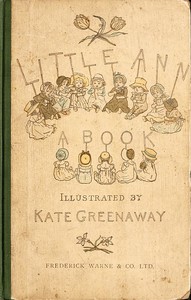
For Little Ann, and Other Poems — Reading Companion, the stored edition analysis reports 11,938 words, 52 min estimated reading time, and 3 detected text sections.
The text analysis averages about 23.3 words per sentence, while the detected sections provide another way to judge how the source is divided.
Project Gutenberg metadata also associates the work with “Children's poetry,” connecting these edition facts with the source record’s subject description.
Explore this collection
These alternatives are selected using recorded categories and estimated reading time.
About 55 minutes
Historical Psychological Social Fiction
12,468 recorded words. 3 minutes difference from this book's estimate.
View Gutenberg source #3753About 48 minutes
Historical Psychological Social Fiction
11,020 recorded words. 4 minutes difference from this book's estimate.
View Gutenberg source #591About 48 minutes
Historical Psychological Social Fiction
10,858 recorded words. 4 minutes difference from this book's estimate.
View Gutenberg source #69761Search stored excerpts and compare books → Choose by your preferences →
Choices use stored catalog measurements. Estimates vary with reading speed. A shared category is a catalog label, not a claim that two books have the same argument or literary quality.
Search reads excerpt text stored with this catalog and links to its associated Gutenberg record. The connection is stored in the site database; this tool does not recheck that every excerpt is word-for-word identical to that external record. Excerpt search does not cover every chapter and does not verify historical publication dates.
Catalog snapshot checked: 2026-09-26. Coverage: 94 public books, 94 available source excerpts.
Calculated from edition completeness, EPUB availability, text structure and catalogue metadata. Not a user rating.
Total of 100 points, scaled to a 2.5-5.0 range. Editions with an empty description or a missing EPUB file are not scored.
Public-domain source text
The source text is kept in the dedicated reader, separate from this catalogue record and its commentary.
In 'Little Ann, and Other Poems,' the Taylor sisters craft verses that double as miniature moral lessons, often staging a child's flaw—vanity, greed, disobedience—against a corrective outcome. The opening poem, 'A True Story,' immediately establishes a class-conscious frame: Little Ann envies a fine carriage, only to be redirected by her mother to a ragged beggar at the same coach door. This pattern of juxtaposing privilege with poverty recurs, as in 'The Vulgar Little Lady,' where Charlotte boasts of her red shoes and lace, and her mother counters that 'nothing's so vulgar as folly and pride.' The poems rely on direct address and simple rhyme schemes, making their ethical points unmistakable.
The Taylors repeatedly use contrast to drive home their lessons. In 'A True Story,' the wealthy ladies in feathers and jewels are set against a beggar with 'naked feet bleed on the stones.' Similarly, 'Sleepy Harry' contrasts the reluctant child with 'the little beggar in the street, / Who wanders with his naked feet' and would be glad to go to bed. This technique extends to character pairs: 'Jane and Eliza' contrasts a naturally good-natured girl with one who 'contrived to look almost as pleasant as Jane' but whose forced smile makes her 'mouth uneasy.' The poems do not simply praise virtue; they dramatize the social and emotional costs of its absence.
Several poems focus on physical care and obedience. 'Washing and Dressing' addresses a child who 'cry[s], and look[s] sulky, and pout[s]' about washing, with the mother reasoning that 'the water grow warmer for all that you've said?' The poem frames hygiene as a kindness, not a punishment. 'Sleepy Harry' treats bedtime resistance as foolishness, noting that birds and ducks 'went to bed an hour ago.' The body is a site of discipline: the child must be washed, dressed, and put to bed, and tears or tantrums are met with calm logic. These poems assume a domestic setting where a mother's authority is gentle but firm, and where compliance is tied to love.
Class distinctions are a recurring concern. 'The Vulgar Little Lady' has Charlotte claim superiority over her nurse because of red shoes and lace, only to be told that 'gentility belongs to no station or place.' 'The Wooden Doll and the Wax Doll' allegorizes social climbing: Blanchidine abandons her plain friend Brunette for a gaudily dressed new acquaintance, but the poem's outcome (in the full text) presumably punishes such snobbery. Even 'A True Story' uses a mother's lesson to reframe envy as a failure of perspective. The poems do not challenge the social order but insist that true worth lies in behavior, not birth or adornment.
Readers approaching this collection should note that the poems are best read as period artifacts of moral instruction rather than as children's entertainment. The Taylors' verse is efficient and often stark, with little ambiguity. Kate Greenaway's illustrations, though not present in this text-only edition, originally softened the didacticism with pastoral charm. For those interested in 19th-century childhood, domestic ideology, or the evolution of children's literature, these poems offer a concentrated sample of the era's pedagogical values.
I remember being struck, reading Little Ann, by how firmly those old verses tied kindness to a child’s place in the world. It made me think of another volume, The Poems of Richard Corbet, late bishop of Oxford and of Norwich 4th edition — Themes and Context, where the same gentle weight of duty and humility lingers, only spoken in a deeper, older voice—like an echo from a quieter parlor.
A brief reflection can help important ideas stay with you longer.









