About 226 minutes
The poems of Mary Howitt — Themes and Context
Historical Psychological Social Fiction
51,863 recorded words. 27 minutes difference from this book's estimate.
View Gutenberg source #76027
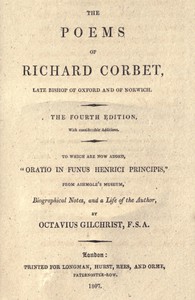
For The Poems of Richard Corbet, late bishop of Oxford and of Norwich 4th edition — Themes and Context, the stored edition analysis reports 45,729 words, 3 hr 19 min estimated reading time, and 59 detected text sections.
The text analysis averages about 26.3 words per sentence, while the detected sections provide another way to judge how the source is divided.
Project Gutenberg metadata also associates the work with “English poetry,” connecting these edition facts with the source record’s subject description.
Explore this collection
These alternatives are selected using recorded categories and estimated reading time.
About 226 minutes
Historical Psychological Social Fiction
51,863 recorded words. 27 minutes difference from this book's estimate.
View Gutenberg source #76027About 155 minutes
Historical Psychological Social Fiction
35,524 recorded words. 44 minutes difference from this book's estimate.
View Gutenberg source #6574About 122 minutes
Historical Psychological Social Fiction
27,946 recorded words. 77 minutes difference from this book's estimate.
View Gutenberg source #847Search stored excerpts and compare books → Choose by your preferences →
Choices use stored catalog measurements. Estimates vary with reading speed. A shared category is a catalog label, not a claim that two books have the same argument or literary quality.
Search reads excerpt text stored with this catalog and links to its associated Gutenberg record. The connection is stored in the site database; this tool does not recheck that every excerpt is word-for-word identical to that external record. Excerpt search does not cover every chapter and does not verify historical publication dates.
Catalog snapshot checked: 2026-09-26. Coverage: 94 public books, 94 available source excerpts.
Calculated from edition completeness, EPUB availability, text structure and catalogue metadata. Not a user rating.
Total of 100 points, scaled to a 2.5-5.0 range. Editions with an empty description or a missing EPUB file are not scored.
Public-domain source text
The source text is kept in the dedicated reader, separate from this catalogue record and its commentary.
Richard Corbet, successively bishop of Oxford and Norwich, wrote poems that blend clerical wit with sharp social observation. This fourth edition, annotated by Octavius Gilchrist, includes a biographical life and the Latin oration for Prince Henry. The excerpts reveal a poet who relishes comic exaggeration, as in the extended satire of Spanish scarcity where eggs are "deare as English capons" and mutton is a felony to cheapen. Corbet's voice is conversational and self-mocking, breaking the fourth wall to admit he must "call for breakfast in" while writing. The edition also preserves the editorial apparatus of Gilchrist, who documents Corbet's family and the circumstances of his preferment.
Corbet's humor often targets physical discomfort and scarcity. In the poem about the Spanish match, he piles up absurd details: meat comes "reeking" when it should be cold, wine is "burnt sack," and a pullet is divided into four quarters like the year. The joke turns on the contrast between reported deprivation and the speaker's own appetite—"I am forc't to call for breakfast in." This self-awareness undercuts the satire, making the poet a participant in the gluttony he mocks. The recurring motif of hunger and surfeit suggests a clerical perspective on courtly excess, where even the news of scarcity becomes a kind of feast for the imagination.
Octavius Gilchrist's annotations frame Corbet as a minor but distinctive figure. He claims only "what to Cæsar is due," refusing to rank Corbet among the higher poets. The life notes that Corbet's father was celebrated by Ben Jonson, and that the poet inherited lands in Watling Street. Gilchrist's tone is scholarly but dry, remarking that Corbet "did not usually conceal his love" and thus likely received no family regard until his elevation. This editorial voice creates a tension between the lively poems and the careful, sometimes pedantic apparatus that surrounds them.
Corbet frequently writes to named individuals—a lord, a duke, a friend—using direct address to create intimacy. The poem excerpted here is structured as a letter, with the speaker reporting news and gossip. The repeated "you" draws the reader into a circle of shared knowledge, while the final lines claim a share in the addressee's greatness. This rhetorical strategy blurs the line between public satire and private correspondence. The poems thus function as performances of friendship, where wit serves to cement social bonds even as it critiques the court.
Corbet's verse is marked by puns and rhythmic surprises. He rhymes "gleeke" with "great" and "Olivares" with "fares," forcing the reader to pause. The meter shifts between iambic regularity and looser, colloquial lines, mirroring the movement from formal address to gossip. In the Spanish poem, the long catalogue of complaints builds to a comic climax: "If first the Belgicke pismire must be seene, / Before the Spanish lady be our queene." The word "pismire" (ant) deflates the diplomatic pretensions, showing Corbet's knack for mixing high and low diction.
Readers will find that Corbet's poems reward attention to their social contexts—the court of James I, the Spanish match, the networks of patronage and friendship. The edition's notes by Gilchrist provide essential background, but the poems themselves are best approached as performances: witty, self-deprecating, and sharply observant. Corbet's voice, at once clerical and worldly, offers a distinctive perspective on the politics and pleasures of early Stuart England.
There’s something endearing about Corbet’s self-aware wit, how he half-smiles at his own poetic appetite, scarcity turned to comedy. It reminds me of sitting with Mary Howitt’s quieter, homelier verses, where the same gentle appetite for small things lingers — The poems of Mary Howitt — Themes and Context — two voices, centuries apart, both knowing that a poem, like a good meal, is best shared with a wink.
Use these questions to collect your thoughts before moving on.









