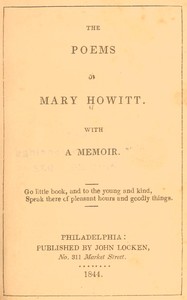
Mary Howitt's 1844 collection opens with a memoir that grounds her poetry in a specific landscape: the 'beautiful Arcadian scenery' of Staffordshire, which she later described in her prose work Wood Leighton. The poems themselves range from hymns and fireside verses to tales in verse and sketches of natural history, with titles like 'The Poor Scholar,' 'The Spider and the Fly,' and 'A Life's Sorrow.' The epigraph—'Go little book, and to the young and kind, / Speak there of pleasant hours and goodly things'—announces a didactic yet gentle intent.
Readers encountering the collection for the first time will find that the excerpts offer a clear sense of Howitt's voice: she favors regular meter, moral clarity, and a close observation of both human emotion and the natural world. The memoir provides biographical context, but the poems themselves reward attention to their structure and recurring concerns.
The Memoir as a Lens
The memoir preceding the poems is not merely biographical filler. It establishes Howitt's lineage—descended from an Irish family and from Wood, 'the ill-used Irish patentee' ruined by Dean Swift—and emphasizes her upbringing among the Society of Friends. This Quaker background may inform the moral seriousness and plainspokenness of many poems. The memoir also notes that the Staffordshire scenery is 'described with great accuracy' in her prose, suggesting that her poetry, too, draws on precise observation of place. Readers can use the memoir as a key to the poems' ethical and geographical preoccupations, but should be cautious not to read every poem as autobiographical.
Moral Drama in 'A Life's Sorrow'
The excerpt from 'A Life's Sorrow' presents a first-person narrative of fraternal estrangement, pride, and belated regret. The speaker describes a brother 'estranged and cold,' their rivalry in love and ambition, and a failed reconciliation at their father's deathbed. The poem's structure—an old man's retrospective account—allows Howitt to explore the long arc of a single sorrow. Key phrases such as 'pride, which was the sin of angels' and 'we were like clay within the potter's hand' reveal a moral vocabulary drawn from Christian tradition. The poem does not resolve into easy forgiveness; instead, it dwells on the 'blighted track' of life. This excerpt shows Howitt's ability to sustain a dramatic monologue over many stanzas, using regular rhyme and meter to control the emotional pitch.
Domestic and Natural Themes
Several titles in the contents point to Howitt's interest in domestic life and the natural world: 'The Poor Man's Garden,' 'The Child and the Flowers,' 'The Sale of the pet Lamb of the Cottage.' The excerpt from the hymn 'A Life's Sorrow' (not to be confused with the longer poem) addresses a mother, urging her to 'rejoice' because her child possesses 'a boundless wealth of love and power' and an 'undying human soul.' This blend of spiritual comfort and natural imagery—'The stars shall dim their brightness; / And as a parched scroll / The earth shall fade'—is characteristic. Howitt often uses simple, concrete images (a garden, a lamb, a child) to anchor larger reflections on mortality and faith. Readers should note how she moves between the particular and the universal within a single poem.
Narrative and Didactic Strategies
Howitt's 'Tales in Verse' section includes titles like 'Andrew Lee,' 'The Wanderer's Return,' and 'The Soldier's Story,' suggesting a preference for narrative poems with clear moral lessons. The excerpt from 'A Life's Sorrow' demonstrates her method: a speaker recounts a personal history, drawing the reader into a cautionary tale about pride and estrangement. The poem's final stanzas (not fully excerpted) likely reinforce the lesson. Similarly, 'The Spider and the Fly'—a well-known poem not excerpted here—is a fable about flattery and deceit. Howitt's didacticism is rarely heavy-handed; she embeds moral instruction within vivid storytelling. First-time readers may find it useful to approach each poem as a small drama, attending to who speaks, to whom, and with what consequence.
This collection rewards a sequential reading, as the memoir sets expectations that the poems variously fulfill and complicate. Howitt's voice is consistent—measured, observant, morally engaged—but her subjects range from the intimate to the historical. Readers should pay attention to the poems' speakers: many are not the poet herself but invented characters (an old man, a mother, a soldier). The result is a volume that feels both personal and crafted, offering a window into the concerns of a 19th-century poet who took her art and her audience seriously.
Mary Howitt’s patient spider, spinning its web of wary arithmetic, reminds me of another quiet watcher—Whitman’s speaker, who finds his own soul in the grass. Both books whisper that caution and wonder can live in the same heart. Curious, how such different voices settle into one shelf, side by side. Leaves of Grass — Story, Setting & Ideas.