About 37 minutes
The Witch of Atlas — Themes and Context
Fantasy Juvenile Worlds
8,356 recorded words. 17 minutes difference from this book's estimate.
View Gutenberg source #4696
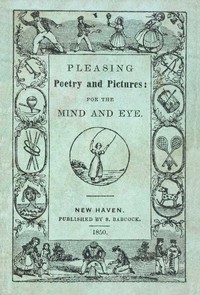
For Pleasing Poetry and Pictures: For the Mind and the Eye — Key Ideas to Explore, the stored edition analysis reports 4,440 words, 20 min estimated reading time, and 9 detected text sections.
The text analysis averages about 22.0 words per sentence, while the detected sections provide another way to judge how the source is divided.
Project Gutenberg metadata also associates the work with “Children's poetry,” connecting these edition facts with the source record’s subject description.
Explore this collection
These alternatives are selected using recorded categories and estimated reading time.
About 37 minutes
Fantasy Juvenile Worlds
8,356 recorded words. 17 minutes difference from this book's estimate.
View Gutenberg source #4696About 42 minutes
Fantasy Juvenile Worlds
9,509 recorded words. 22 minutes difference from this book's estimate.
View Gutenberg source #75153About 53 minutes
Fantasy Juvenile Worlds
12,081 recorded words. 33 minutes difference from this book's estimate.
View Gutenberg source #1830Search stored excerpts and compare books → Choose by your preferences →
Choices use stored catalog measurements. Estimates vary with reading speed. A shared category is a catalog label, not a claim that two books have the same argument or literary quality.
Search reads excerpt text stored with this catalog and links to its associated Gutenberg record. The connection is stored in the site database; this tool does not recheck that every excerpt is word-for-word identical to that external record. Excerpt search does not cover every chapter and does not verify historical publication dates.
Catalog snapshot checked: 2026-09-26. Coverage: 94 public books, 94 available source excerpts.
Calculated from edition completeness, EPUB availability, text structure and catalogue metadata. Not a user rating.
Total of 100 points, scaled to a 2.5-5.0 range. Editions with an empty description or a missing EPUB file are not scored.
Public-domain source text
The source text is kept in the dedicated reader, separate from this catalogue record and its commentary.
The opening poem of Pleasing Poetry and Pictures directly addresses a child reader named Mary, celebrating her ability to read “such a beautiful book.” This self-referential framing—a book praising its own use—sets the tone for a collection that consistently ties literacy to moral improvement. Published in 1849 by S. Babcock of New Haven, the volume pairs anonymous verses with wood engravings by Alexander Anderson, a prominent American illustrator. The catalog subjects—children’s poetry and conduct of life—are borne out in the excerpts, but the poems often exceed simple didacticism through concrete, sometimes startling imagery.
The most famous poem in the collection, “The Little Busy Bee,” adapts Isaac Watts’s “Against Idleness and Mischief” with a direct warning: “For Satan finds some mischief still / For idle hands to do.” The bee’s industry—gathering honey, building cells, spreading wax—is presented as a model for children, who must be “busy too” in “books, or work, or healthful play.” Yet the poem’s logic is not merely practical; it frames time as a spiritual accounting, urging the child to “give for every day / Some good account at last.” This tension between earthly diligence and heavenly reckoning recurs throughout the volume.
“The Dead Bird” offers a stark counterpoint to the bee’s cheerful labor. The poem describes a lark shot for sport, its “pretty head” pierced and its “shining wing” broken. The speaker dwells on the bird’s morning song and its nestlings, who will “with hunger die, / All in the open air.” The moral is explicit: “What we call Sport is too often Cruelty.” Unlike the bee poem’s abstract sin of idleness, this one grounds its lesson in a visceral scene—the “dull and dim” eyes, the “cold, and stiff, and still” body. The poem suggests that even boys, if they understood the bird’s sorrow, would abandon such “frightful gun[s].”
“My Kind Mother” shifts from animal examples to domestic duty. The child speaker promises not to tease, to mind every word, and to step “most silently” when the mother has a headache. The poem roots this obedience in gratitude: the mother once let the baby “in her bosom sleep” and tended the child through sickness. The father’s reported words—“when I was in my cradle sick, / She tended me all day”—reinforce the mother’s care as a debt the child must repay through quiet behavior. The poem’s repetitive structure (“I must not tease my mother”) turns the lesson into a chant, embedding the rule through rhythm rather than argument.
Readers approaching Pleasing Poetry and Pictures should note that the excerpts represent only a fraction of the volume’s nine sections. The poems vary in length and complexity, and the wood engravings—credited to Anderson but not reproduced in this digital edition—likely shaped how the verses were received. The collection rewards attention to its small verbal details: the way a bee’s “shining hour” echoes a bird’s “shining wing,” or how the promise to “give for every day / Some good account” resonates with the dead bird’s final silence.
I remember the 1849 volume’s woodcuts—that busy bee, the solemn dead bird—and how they taught patience through pictures. Some years later, I found myself lingering over The three sphinxes, and other poems — A Closer Reading, sensing a shared quietness, as if both books understood that wonder works slowly, like old ink settling into paper.
Use these questions to collect your thoughts before moving on.









