About 399 minutes
Hudibras, in Three Parts, Written in the Time of the Late Wars — Themes and Context
Fantasy Juvenile Worlds
91,570 recorded words. 77 minutes difference from this book's estimate.
View Gutenberg source #4937
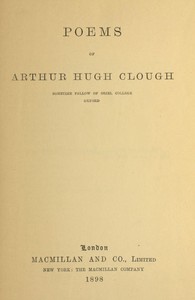
Poems of Arthur Hugh Clough — Background and Themes can be approached with a clearer sense of reading commitment from its source measurements: 109,429 words, 7 hr 56 min estimated reading time, and 29 detected text sections.
The text analysis averages about 23.1 words per sentence, while the detected sections provide another way to judge how the source is divided.
Project Gutenberg metadata also associates the work with “English poetry -- 19th century,” connecting these edition facts with the source record’s subject description.
Explore this collection
These alternatives are selected using recorded categories and estimated reading time.
About 399 minutes
Fantasy Juvenile Worlds
91,570 recorded words. 77 minutes difference from this book's estimate.
View Gutenberg source #4937About 305 minutes
Fantasy Juvenile Worlds
70,093 recorded words. 171 minutes difference from this book's estimate.
View Gutenberg source #32767About 222 minutes
Fantasy Juvenile Worlds
50,955 recorded words. 254 minutes difference from this book's estimate.
View Gutenberg source #2428Search stored excerpts and compare books → Choose by your preferences →
Choices use stored catalog measurements. Estimates vary with reading speed. A shared category is a catalog label, not a claim that two books have the same argument or literary quality.
Search reads excerpt text stored with this catalog and links to its associated Gutenberg record. The connection is stored in the site database; this tool does not recheck that every excerpt is word-for-word identical to that external record. Excerpt search does not cover every chapter and does not verify historical publication dates.
Catalog snapshot checked: 2026-09-26. Coverage: 94 public books, 94 available source excerpts.
Calculated from edition completeness, EPUB availability, text structure and catalogue metadata. Not a user rating.
Total of 100 points, scaled to a 2.5-5.0 range. Editions with an empty description or a missing EPUB file are not scored.
Public-domain source text
The source text is kept in the dedicated reader, separate from this catalogue record and its commentary.
Arthur Hugh Clough’s verse resists easy categorization, veering from the compressed moral anxiety of ‘The Latest Decalogue’ to the sprawling hexameters of The Bothie of Tober-na-Vuolich. The excerpts show a poet who treats meter as a flexible instrument: the long-vacation pastoral moves with the loose gait of classical epic, while shorter lyrics tighten into epigrammatic force. Clough’s speakers often inhabit a state of suspended judgment, weighing duty against desire, faith against skepticism. The voice in ‘Dipsychus’ oscillates between self-mockery and earnest debate, and the love scenes in The Bothie unfold through hesitant, interrupted dialogue. Across these poems, Clough experiments with how much narrative weight a line can carry before breaking into prose.
Clough’s use of the dactylic hexameter in The Bothie of Tober-na-Vuolich is not merely a classical exercise. He bends the long line to accommodate the rhythms of spoken English, especially in moments of emotional tension. When Elspie confesses her earlier observations of Philip, the meter stumbles and recovers: ‘That was what gave me much pain, when I met you that dance at Rannoch, / Dancing myself too with you, while Katie danced with Donald.’ The line breaks mimic a speaker pausing, then pressing on. Clough also exploits the hexameter’s capacity for enjambment, letting syntax spill across line ends to mirror the characters’ unfinished thoughts. The result is a pastoral that feels both antique and immediate, where the meter itself becomes a record of hesitation.
Clough’s characters often talk past one another, their speeches layered with unspoken reservations. In the excerpt from The Bothie, Philip and Elspie conduct a courtship that is as much about misdirection as revelation. Elspie’s knitting needles provide a counter-rhythm to her words; she speaks ‘quietly, after her fashion, still knitting.’ Philip’s outburst—‘O Elspie, you only I love’—is immediately undercut by his own doubt: ‘you cannot believe it, and should not.’ The dialogue is built from interruptions, self-corrections, and the kind of repetition that signals anxiety. Clough’s ear for the way people actually speak—halting, qualifying, retreating—gives these exchanges a psychological density rare in Victorian verse.
The collection juxtaposes poems of tight formal control with passages of loose, almost novelistic exposition. A short lyric like ‘The Latest Decalogue’ compresses moral critique into ten lines of rhyming couplets, each line a dagger. In contrast, The Bothie expands into a full narrative with named characters, setting, and sustained dialogue. The shift is not just in length but in the poet’s relationship to time: the lyric dwells in a single moment of insight, while the pastoral moves through days and seasons. Clough also experiments with fragments—‘Dipsychus Continued’ breaks off mid-scene, and ‘Mari Magno’ frames tales within a voyage. These structural choices suggest a poet more interested in process than resolution, more comfortable with the open end than the epigrammatic close.
Readers coming to Clough for the first time may find it useful to start with the shorter poems—‘The Latest Decalogue,’ ‘Qua Cursum Ventus’—to gauge his epigrammatic style before tackling the longer works. The hexameter pastorals reward slow reading, especially aloud, to catch the interplay of meter and meaning. Clough’s voice is that of a skeptic who nonetheless believes in the seriousness of form; his poems ask questions they do not answer, and that is their enduring strength.
Clough’s quiet wrestling with doubt and duty stayed with me long after I closed the book, like a half-heard melody in a familiar room. That same tenderness for how we hold feeling and thought together seems to live in Pleasing Poetry and Pictures: For the Mind and the Eye — Key Ideas to Explore, a gentler sort of companion for those same lingering hours.
Capture what you thought, learned, and would like to remember.









